

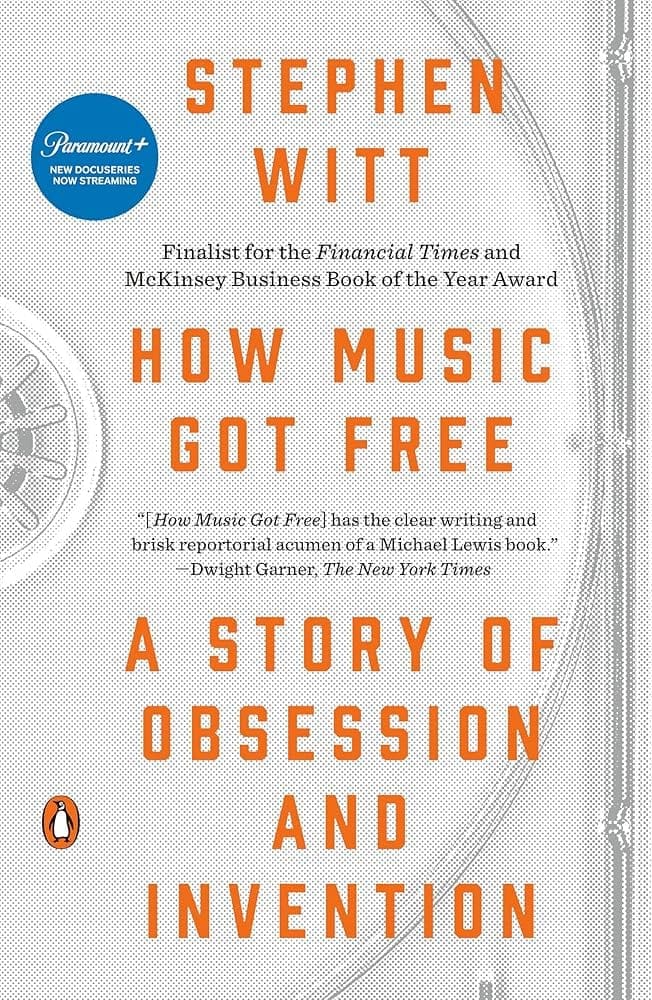
How Music Got Free can be read as a fun nostalgia piece about Napster.
Or as a solemn, cautionary tale about piracy. snigger… snort…
I loved it as an autopsy report.
Stephen Witt tells a genuinely fantastic story about music. What he also documents—possibly without realizing it—is a beautiful moment when gatekeeping stopped working.
Not philosophically.
Energetically and structurally.
Gatekeeping, and “The Music Industry” didn’t lose control because people were immoral, lazy, or entitled.
It lost control because centralized authority cannot survive an awakening.
It’s the Same Pattern throughout time:
- Control systems depend on scarcity
- Scarcity depends on enforced ignorance
- Ignorance collapses the moment people share notes
Digitization didn’t “enable piracy.”
It exposed a set of assumptions masquerading as rights:
- that restricting access is justified because money or power
- that control is the same thing as value
- that permission is what legitimizes knowing
bahahahah.
One of the most delightful aspects of this book is who wasn’t responsible for the collapse:
Not activists. (Sorry, Karen – you are irrelevant)
Not even the artists.
Not philosophers.
It was technicians. Nerds. Rippers. Insiders. Obsessives.
My people.
People following inner knowing, not permission.
This matters because it exposes a taboo truth:
Real change never comes when authority allows something.
It comes when enough people notice the system no longer makes sense—and that noticing becomes cumulative.
Awakenings don’t wait for approval.
“Piracy” Is a Control Word
The industry’s response was entirely predictable:
- Rename systemic obsolescence as “theft”
- Moralize behavior instead of examining structure
- Protect intermediaries while pretending to protect creators
This is classic linguistic warfare.
This is a word spell.
“Piracy” is designed to collapse discernment by triggering guilt, fear, and false binaries—lawful vs. criminal, ethical vs. immoral—so the underlying structure is never examined.
The same script is now used to police access to:
- Medical information
- Historical archives
- Esoteric texts
- Technical manuals
- Academic research
Different domain.
Same control pattern.
And here’s the part I find genuinely funny:
My country was founded by revolutionaries, smugglers, pirates, and traitors to empire. The original “criminals” were simply people who refused to accept imposed authority.
So no—piracy doesn’t read to me as shameful.
It reads as unauthorized navigation.
Independent trade routes.
People choosing the open sea over permission slips.
I find the word inspiring.
The Lie Beneath the Law
What this book quietly confirms is something institutions cannot admit:
Artists were never the primary beneficiaries of restriction.
Middlemen were. Once distribution no longer required them, their authority became performative—maintained by lawsuits, propaganda, and nostalgia.
That’s not capitalism.
That’s resource hoarding cosplaying ethics.
Gatekeeping Is Already Dead
This is the part most readers miss.
Gatekeeping didn’t win when Napster went down.
Napster went down because gatekeeping had already failed and middlemen clamped down, made examples, panicked… Too Late, Muthafuckers…. People have stopped asking permission from Big Daddy.
By the time enforcement arrived, the pattern already propagated.
Shadow libraries, decentralized archives, and parallel knowledge systems are not fringe rebellions.
They are signals of a consciousness shift.
When inner knowing outranks expert consensus, enforcement loses teeth.
You cannot prosecute millions of people out of a new paradigm.
The Arc Continues
Every industry built on:
- Artificial scarcity
- Credentialed access
- Centralized epistemic authority
Is already obsolete—whether it knows it or not.
Music was simply the first to fall.
Books, medicine, science, spirituality, and education are now following the same arc music did: centralized control clamping down in a desperate bid to survive in a world where knowledge is already decentralized.
Enter Anna’s Archive
This is where Anna’s Archive comes in.
For readers unfamiliar: Anna’s Archive is a public-facing search index that aggregates links to digitized books and papers from multiple shadow libraries. It doesn’t posture as a movement or an ideology. It exists because the material already exists—and because official channels have made access artificially difficult, expensive, or conditional.
In other words, Anna’s Archive is both a beautiful rebellion and an infrastructure response.
It doesn’t represent a future threat to publishers or institutions.
It represents a present reality they failed to adapt to.
Just as Napster revealed that the music industry no longer controlled distribution, Anna’s Archive reveals that knowledge gatekeeping has already lost its leverage.
By the time enforcement narratives appear—copyright, liability, ethics—the pattern has already propagated. The information is mirrored. The pathways exist. The public has learned that permission is optional.
This isn’t about people becoming unethical.
It’s about people becoming self-sovereign.
And once that threshold is crossed, systems never regain their former authority.
How Music Got Free is valuable precisely because it is – possibly- unintentionally honest. I say possibly because the author may have just done exactly what he set out to do without being obvious enough to be censored. If so, BRAVO.
It documents the moment a control system realized—too late—that it never owned culture.
It only rented compliance.
And compliance has an expiration date.
Gatekeeping is not under attack.
It is already dead.