

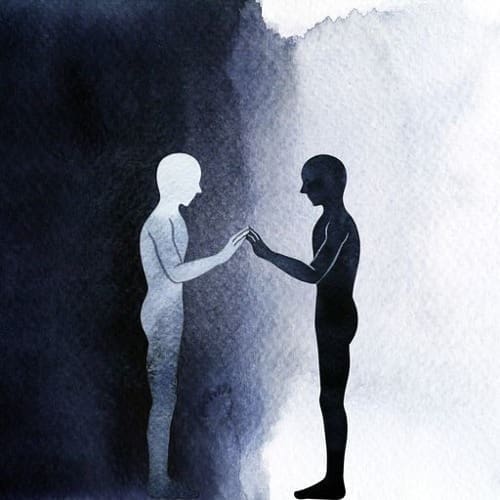
The quality you cannot stand in another person is almost always a quality you have refused to see in yourself. Not necessarily the exact behavior — but the root beneath it. The fear beneath their arrogance. The wound beneath their need for control. The self-doubt beneath their perfectionism. The insecurity beneath their love bombing. Whatever it is, when it lives in you unnamed, it will find you in the world outside wearing someone else’s face.
This is what shadow alchemy means in practice.
Not reliving your trauma in loops.
Not making your wounds your identity.
Not spending years analyzing why you are the way you are.
It means asking one precise question every time you feel a strong reaction:
What is this peeve about another showing me about myself that I haven’t been willing to see?
The Method
I did this for the first time today.
Not knowing how else to begin, I gave myself one instruction:
“I cannot stand this about this person.”
No cleanup. No apology.
Instead of worrying about projecting or whether I “shouldn’t judge,” I followed the thread down into the root:
- What is the energy underneath that behavior?
- Where does that same energy live in me—just expressed differently?
Not the same action.
The same root system.
The Starting Point
Of course I started closest to home:
“I cannot stand when Bear always finds something to complain about. He has no joy.”
That’s the surface.
Until now, I would stop there and just decide he was wrong.
This time, I stayed with the pattern.
What do I actually believe when he does this?
“Nothing is ever good enough.”
And Then the Mirror Turned
Because I don’t act like that.
I see the good.
I value the good.
So where is that same root in me?
It landed clean:
“There is never enough good.”
Distrust of its continuity.
Same Root. Different Strategy.
He protects himself from losing good by never fully accepting it.
I protect myself from losing good by trying to secure it.
That shows up in real life like:
- Stockpiling things I love
- Buying backups of anything that feels “good”
- Creating environments where I control comfort and safety
I’ve packed hotel rooms like I’m relocating permanently:
- my own blankets
- crystals
- oils
Anything that ensures I will be okay.
Because somewhere in me is the quiet assumption:
“If I don’t create the safety, it won’t be there.”
Where That Actually Came From
My reaction to Bear isn’t about Bear.
It’s about this:
I was good. And no one recognized or protected it.
My stepmother physically abused me.
My father allowed it.
No one stepped in to say:
- you matter
- you’re safe
- you’re worth protecting
- you are what’s good in this world
I fought, as a tiny girl, for my own value.
And that becomes a system:
“If I don’t recognize and protect the good, no one will.”
So When Bear Complains…
It doesn’t only feel annoying, It feels like:
“You’re wasting something I had to fight to make real.”
And deeper:
“You’re not recognizing something that matters.”
And even deeper:
“You’re not recognizing me.”
This is where I took a long break from writing to cry…. ok, back now.
Now we’re not talking about personality differences.
We’re looking at a live wire:
My own Unfinished attempts to resolve the past in the present.
When I get angry at him for not seeing the good, what’s underneath is:
“This time, you must see it. This time, it will be acknowledged.”
That’s not about him.
That’s about a moment that never completed.
There were some strengths I built from this same place:
- Self-sufficiency
- High discernment
- Ability to create my own safety
- Not requiring external validation
I learned not to rely on anyone else to hold me safe.
So I became one who:
- prepares
- secures
- stabilizes
Which Means I Rarely allow myself to Experience Being Held
My system runs like this:
- Assess the environment
- Assume it won’t meet me
- Build what I need myself
- Relax once it’s under control
It works. But it also means: I don’t often leave space for anything or anyone else to actually meet me there.
The Connection Back to Bear
Now I can see a hidden dynamic:
- He glosses over the good
- I over-recognize and over-protect it
And when he doesn’t meet it, my system freaks out because: “Augh! I still have to do this for myself?.”
So What Is the Shadow?
Not my ability to see good.
Not my ability to create safety.
The shadow is this belief:
“Good only survives because I protect it — and if I stop, it might disappear.”
And the Grief Underneath It
This is what cracked open in my heart:
No one protected or celebrated me when I needed it most.
That’s the part that still reacts.
Not because it’s weak.
Because it never got completed.
What Integration Actually Looks Like
Not pretending it doesn’t bother me.
Not tolerating behavior I don’t like.
It’s this:
Learning to separate what is happening now from what I am trying to resolve from the past.
And slowly releasing the need for others to recognize the good in order for it to feel real or safe.
The Shift (Simple, Not Easy)
From:
“I have to recognize the good — and force others to do the same.”
To:
“I can access and generate good, even if no one else sees or holds it.”
The Question I’m Sitting With Now
If no one else appreciated the good, Would what’s good still be true?
My Shadow Alchemy lives
Not in fixing other people.
Not in becoming less discerning and ignoring this thing that bothers me.
But in taking that moment where I am bothered by this specific peeve, to recognize an opportunity to hug the part of me that still believes:
“It’s all on me.”